
Fanous · Arabic stories for children
Learn to read Arabic for kids, one short story at a time
For children aged 4–7 who know their letters and are ready for real sentences. The child listens while each word lights up, follows along, then reads the page alone. Book 1 is free.
Last reviewed:
A child who knows the Arabic letters is not yet a reader. The step in between, from single letters to whole sentences, is where most children get stuck and where most parents run out of ideas. Short stories help because they give the child a reason to reach the next line: they want to know what Juha does next.
Listen, follow, read: the three steps
This is the simplest routine we know, and it fits in ten minutes.
- Listen. Play one page. A clear Arabic voice reads it while each word lights up as it is spoken. The child only watches and listens.
- Follow. Play the same page again. This time the child points at each word as it lights up, and says the words along with the voice if they like.
- Read. Stop the voice. The child reads the page aloud alone, and taps any word they are unsure of to hear it again.
Do not correct every slip. If the child reads a word wrongly, tap it, listen together and move on. The aim in the first months is confidence and a daily habit.
Why the stories are fully vowelled
Everyday Arabic is printed without the short vowel marks, so a beginner has to guess how a word sounds. In these stories every word carries its marks, which means a child can work out a new word alone. There is more about this on the page about Arabic stories with tashkeel.
The language is simple Modern Standard Arabic, the Arabic of school books, in sentences short enough for a child of five or six to hold in mind.
Start with a free story
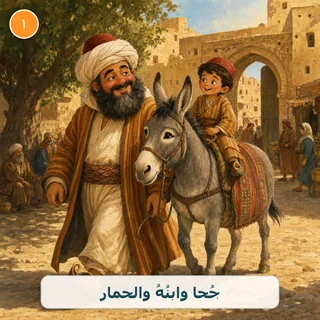
Book 1 of each series is free after you sign in with an email. For a young child, begin with Juha, His Son, and the Donkey: Juha and his son Saber walk to the market, and whatever they do, somebody complains.
-
Free
 Book 1
Juha, His Son, and the Donkey
جُحا وابنُهُ والحمار
Juha and his son try every way to ride their donkey — and please no one.
-
Free
 Book 1
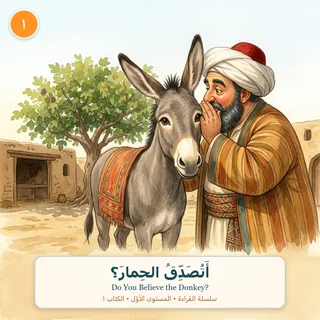
Do You Believe the Donkey?
أَتُصَدِّقُ الحِمارَ؟
Juha tells his neighbour the donkey isn't home — and the donkey brays.
The next ten stories: the shortest pages
Juha's Tales has 28 picture books for ages 4–7, in three reading levels. Level 1 has two to four short sentences on a page and about 330 to 365 Arabic words in a book. That is enough for one sitting. In "Juha and the Branch He Was Cutting" Juha saws the branch he is sitting on. In "Juha Carries the Door on His Back" he is told to guard the door, so he takes it with him. Children laugh, and then they ask to hear it again, which is exactly the repetition a new reader needs.
-
 Book 2
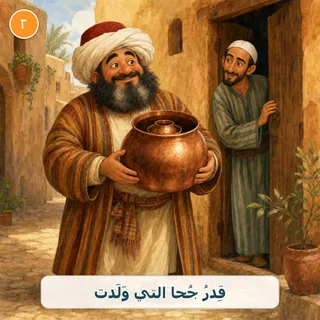
Juha's Pot That Gave Birth
قِدرُ جُحا التي وَلَدت
The borrowed pot “gives birth” — so why can't it die? A witty lesson in fairness.
-
 Book 3
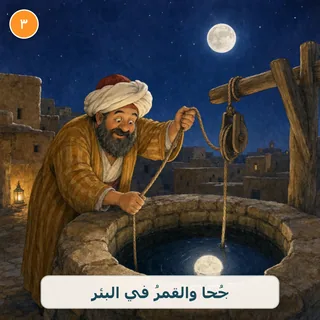
Juha and the Moon in the Well
جُحا والقمرُ في البئر
Juha heroically “rescues” the moon from the well — and learns about reflections.
-
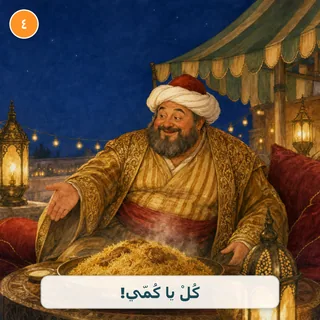 Book 4
Eat, O My Sleeve!
كُلْ يا كُمّي!
Snubbed in old clothes, honoured in a splendid robe — so Juha feeds the robe.
-
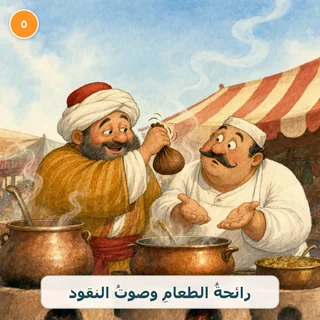 Book 5
The Smell of Food and the Sound of Coins
رائحةُ الطعامِ وصوتُ النقود
A cook charges for the smell of food; Juha pays him with the sound of coins.
-
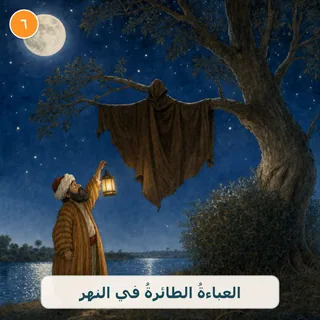 Book 6
The Cloak That Flew into the River
العباءةُ الطائرةُ في النهر
A “stranger” in the tree turns out to be Juha's own washed cloak — thank God he wasn't in it!
-
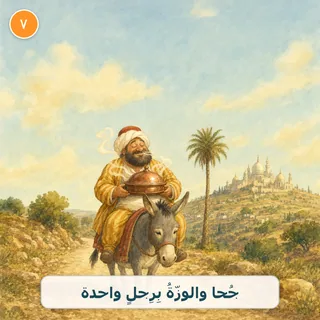 Book 7
Juha and the One-Legged Goose
جُحا والوزّةُ بِرِجلٍ واحدة
Juha eats one goose leg, then proves all geese have one leg — until the drums roll.
-
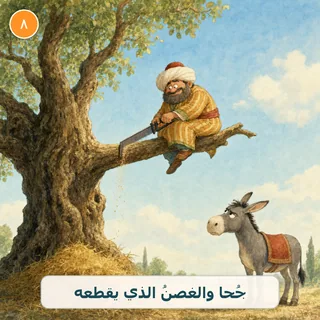 Book 8
Juha and the Branch He Was Cutting
جُحا والغصنُ الذي يقطعه
Sitting on the very branch he saws, Juha ignores good advice — once.
-
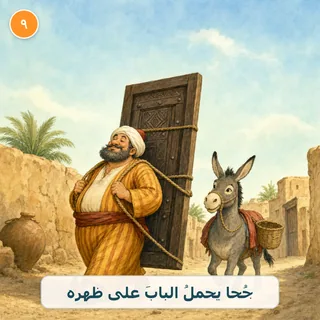 Book 9
Juha Carries the Door on His Back
جُحا يحملُ البابَ على ظهره
No door, no burglars? Juha takes home security very literally.
-
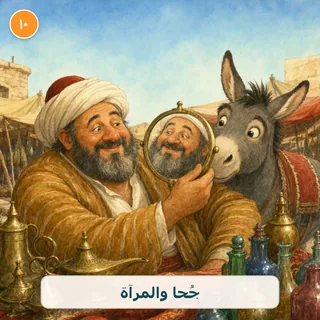 Book 10
Juha and the Mirror
جُحا والمرآة
One mirror, three different “portraits” — a warm family puzzle about seeing ourselves.
-
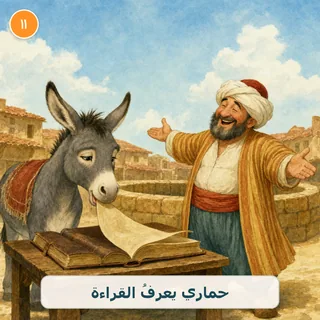 Book 11
My Donkey Can Read
حماري يعرفُ القراءة
With barley between the pages, Juha's donkey learns to “read” — and reviews the book out loud.
After these, the full Juha's Tales series goes on to Level 2 and Level 3 with slightly longer pages.
A ten-minute daily routine
- Same time every day. Before bed works well for most families.
- One story, or half of one. Stop while the child still wants more.
- Read the same book several nights running. Reading a familiar page smoothly feels better than struggling through a new one.
- Slow the voice to 0.75× at first, and move back to normal speed when the child keeps up.
- Ten minutes of reading or listening keeps the day streak going, and children like watching it grow.
The For Parents page has more on the read-aloud and a bedtime routine.
Common questions
At what age can a child start?
Children of four or five can start by listening and watching the words light up, even before they know all the letters. Reading a page alone usually comes later, once the child knows the letters and the vowel marks. The Juha series is written for ages 4–7.
How long should we read each day?
Ten minutes is enough, and it is better than an hour once a week. Ten minutes of reading or listening keeps the day streak, and twenty minutes is the daily goal for children who want more. End each sitting on a page the child enjoyed.
I do not read Arabic. Can I still help?
Yes. The narrator reads every page, so your job is to sit beside your child, press play and ask what happened. Each Juha book has an English "For Parents" page with a summary, a question and ten key words with their pronunciation.
What comes after the first ten stories?
Move up inside the same series. Level 2 books such as "Juha Counts the Donkeys and Forgets Himself" have a little more text, and Level 3 books such as "The Nail in the House" are the longest. Older children can go on to Arabic Readers Level 1.