
Fanous · Arabic stories for children
Arabic stories for learners: teens and adults, about A2
For teens and adults learning to read Arabic at about A2, and older children from about 10. You listen while each word lights up, read the scene in Arabic, then check it in English. Book 1 is free.
Last reviewed:
Once the alphabet is done, most learners hit the same wall: textbooks have dialogues about airports, and real Arabic books are far too hard. Graded stories fill that gap. Arabic Readers Level 1 gives you fifteen classic tales, retold in simple Modern Standard Arabic that an A2 reader can finish in one or two sittings.
How each reader is built
- Six short scenes, 600 to 700 Arabic words in the whole book.
- Arabic first, then English. Every scene appears in Arabic and is followed by the same scene in natural English, so you can check your understanding without a dictionary.
- Full vowel marks on every Arabic word, so you always know how a word is said. See Arabic stories with tashkeel for why that matters.
- Read aloud in both languages. Each word lights up as it is spoken. Tap any word to hear it again, and set the speed anywhere from 0.75× to 1.25×.
- A glossary with pronunciation for the key words of the tale.
The four-step practice
Every scene has the same practice loop. It takes a few minutes and turns passive reading into speaking.
- Listen. The scene is read to you with the text on screen and each word lighting up.
- Read along. Go through the text at your own pace and tap any word you are unsure of.
- Repeat. The voice reads one sentence and pauses, and you say it back.
- Read aloud. Read the scene into the microphone and see how many words matched.
The fifteen tales
The series draws on four sources, so you learn the stories Arabic speakers grew up with as well as the language.
- Juha, the wise fool of Arabic humour, in six books, including "Juha and Tamerlane's Elephant" and "Juha Before the Judge".
- Kalila wa Dimna, the old animal fables: "The Monkey and the Tortoise", "The Ringed Dove and Her Friends", "The Owls and the Crows", "The Lion and the Ox" and "The Hermit and the Weasel".
- The Thousand and One Nights: "Ali Baba and the Forty Thieves" and "The Fisherman and the Jinni".
- Arabic legend: "Hatim al-Tai's Generosity" and "Abu al-Qasim's Unlucky Shoes".
-
Free
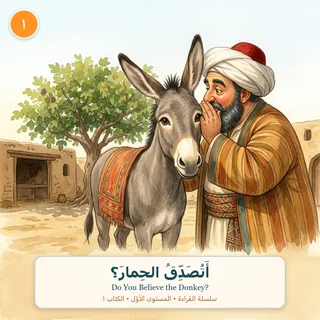 Book 1
Do You Believe the Donkey?
أَتُصَدِّقُ الحِمارَ؟
Juha tells his neighbour the donkey isn't home — and the donkey brays.
-
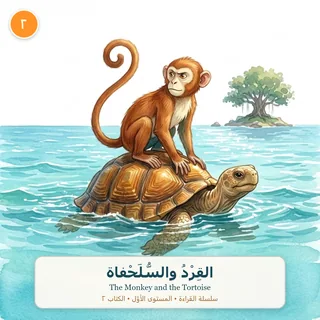 Book 2
The Monkey and the Tortoise
القِرْدُ والسُّلَحْفاة
Halfway across the sea, the monkey learns his friend wants his heart.
-
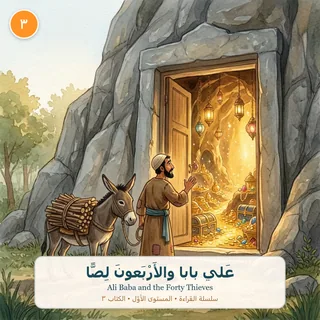 Book 3
Ali Baba and the Forty Thieves
عَلي بابا والأَرْبَعونَ لِصًّا
"Open, Sesame!" — two magic words, one greedy brother and a very clever servant.
-
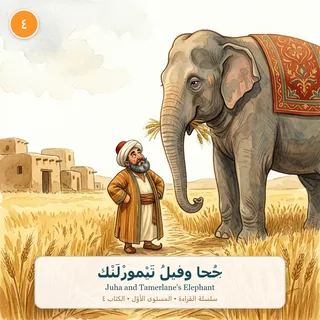 Book 4
Juha and Tamerlane's Elephant
جُحا وفيلُ تَيْمورْلَنْك
The villagers want Juha to complain to the emperor — then they vanish one by one.
-
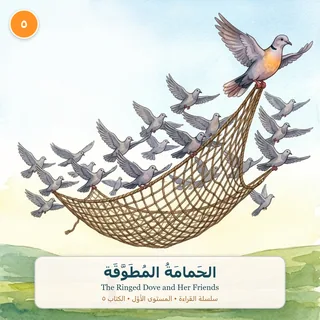 Book 5
The Ringed Dove and Her Friends
الحَمامَةُ المُطَوَّقَة
A flock trapped in a net, a mouse with sharp teeth, and friends who never leave each other.
-
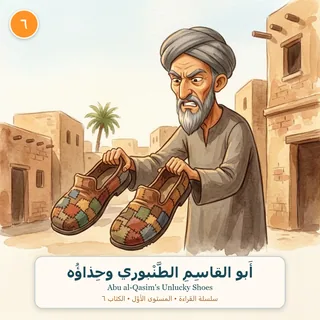 Book 6
Abu al-Qasim's Unlucky Shoes
أَبو القاسِمِ الطَّنْبوري وحِذاؤُه
A stingy man tries to get rid of his old shoes — and they keep coming back.
-
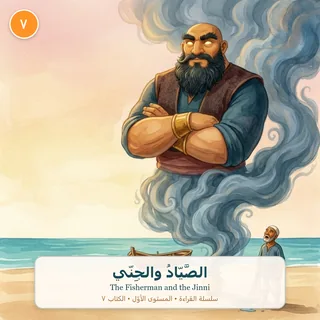 Book 7
The Fisherman and the Jinni
الصَّيّادُ والجِنّي
A poor fisherman opens a sealed brass jar — and a furious giant rises out of it.
-
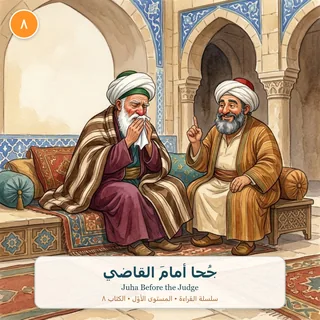 Book 8
Juha Before the Judge
جُحا أمامَ القاضي
Juha tells both men they are right — and then tells the judge he is right too.
-
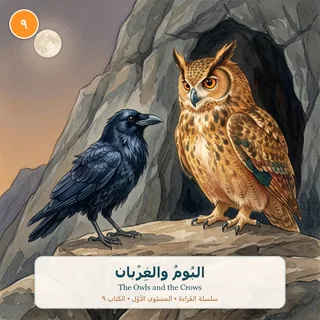 Book 9
The Owls and the Crows
البُومُ والغِرْبان
One old crow walks into the enemy's cave alone — with a plan.
-
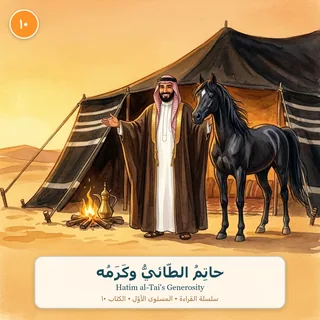 Book 10
Hatim al-Tai's Generosity
حاتِمُ الطّائيُّ وكَرَمُه
A king sends men to ask for Hatim's famous horse. Hatim has already served it for dinner.
-
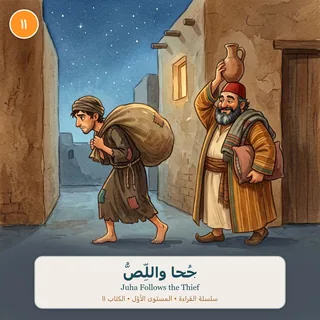 Book 11
Juha Follows the Thief
جُحا واللِّصُّ
A thief robs Juha's house at night — and Juha follows him home with the rest.
-
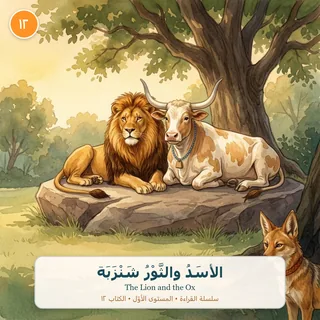 Book 12
The Lion and the Ox
الأسَدُ والثَّوْرُ شَنْزَبَة
A lion and an ox become true friends — until a jealous jackal starts whispering.
-
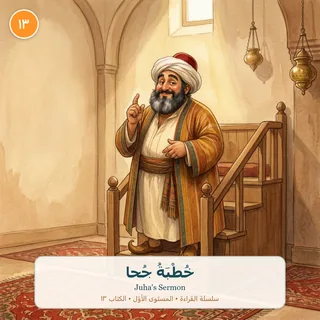 Book 13
Juha's Sermon
خُطْبَةُ جُحا
"Do you know what I'm going to say?" Juha's shortest talks ever.
-
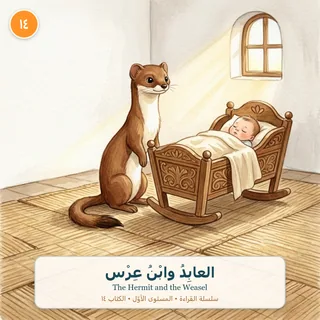 Book 14
The Hermit and the Weasel
العابِدُ وابْنُ عِرْس
A faithful weasel guards a baby — and one moment of haste changes everything.
-
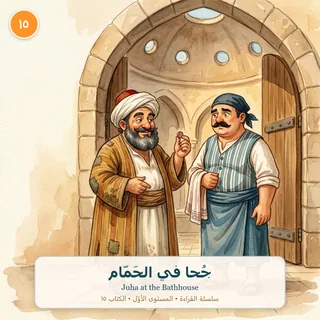 Book 15
Juha at the Bathhouse
جُحا في الحَمّام
Ignored in old clothes, Juha tips in gold. Treated like a prince, he tips a copper.
The Arabic Readers Level 1 series page has a summary and key words for each book.
Where to begin
Start with the free Book 1, Do You Believe the Donkey?. Juha tells his neighbour the donkey is away, and the donkey brays from the stable at that very moment. The full text is on that page, so you can test the level before you sign in.
After that, choose by taste. The Juha books are the lightest and funniest. The Kalila wa Dimna fables have more dialogue and argument. The two tales from the Nights have the most plot. If you prefer listening before reading, there is more on the audio stories page.
A steady pace works best: one scene a day through the four steps, then the whole book again at the weekend. Ten minutes a day keeps your day streak, and twenty minutes is the daily goal.
Common questions
What level of Arabic do I need?
You should know the alphabet and be able to sound out vowelled words slowly. The readers are at about CEFR A2. Because every scene is followed by its English version, a determined beginner can manage them, and people who understand spoken Arabic but read slowly will find them comfortable.
Is this Modern Standard Arabic or a dialect?
Modern Standard Arabic, also called fusha: the written language shared across the Arab world and used in books, news and school. The sentences are short and the vocabulary is kept simple, and every word carries its vowel marks.
Do I need a teacher?
No. The readers are made for self-study: audio, English for every scene, a glossary and the four-step practice. A single scene also works as a short reading text for a lesson, and the books suit families reading with children of about ten and up.
How does the read-aloud step work?
In the fourth step you read the scene into your device's microphone. When you finish, you see how many of the words matched the text. There is no mark and no pass or fail. Try the same scene again later and compare.
How much does the series cost?
Book 1 is free. Every other book costs $3.99, and all fifteen readers together cost $34.99. The bundle also includes any books added to Level 1 later. One account works on up to six devices.